

HERO OR VILLAIN?
Step inside Aarhus’ old police station, which from the autumn of 1944 served as the headquarters of the feared German secret police, the Gestapo.
Through interactive exhibitions, personal accounts and historical objects, you are invited to form your own opinion. You will not be presented with simple answers, but encouraged to reflect: What would you have done?
The Occupation Museum is a vivid and relevant experience where history is not merely told, but felt – and where the dilemmas of the past shed light on the moral choices of the present.
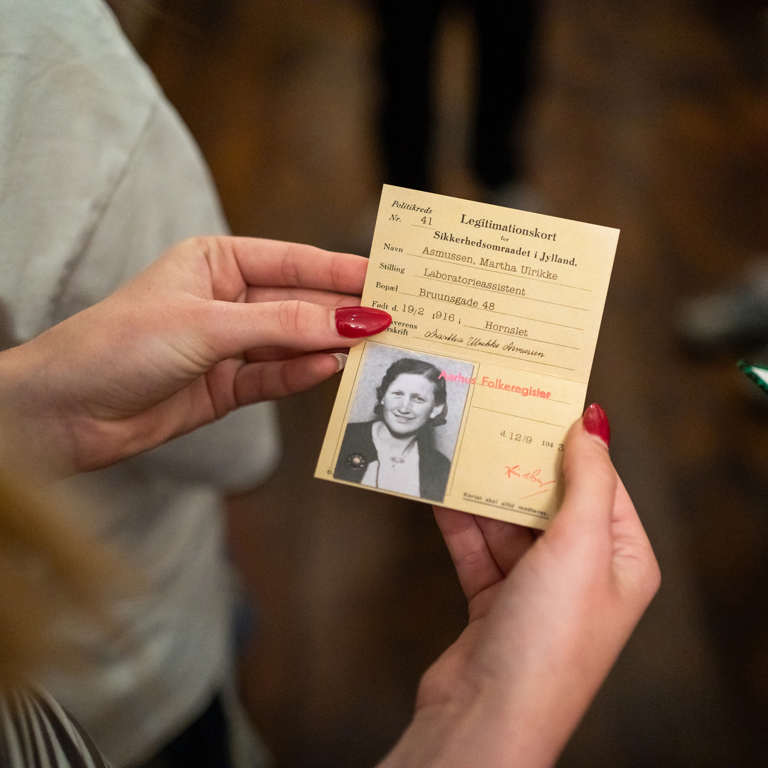
With the identity card in hand, you can follow a personal story and gain a close insight into the dilemmas of the occupation.
ABOUT THE MUSEUM
The Occupation Museum Aarhus is a powerful and thought-provoking museum that brings the stories of the occupation in Aarhus from 1940 to 1945 closer to visitors today. The museum goes beyond traditional historical interpretation, focusing instead on the difficult choices people faced during the war – choices where the boundaries between right and wrong were often unclear.
The building was first a town hall and later a police station. From the autumn of 1944 until the liberation, it served as the headquarters of the feared German secret police, the Gestapo. The preserved cells and basement rooms provide the setting for an exhibition about everyday life, the resistance movement and Nazi oppression.
PURPOSE
The purpose of the museum is to document, preserve and communicate the history of the occupation in Aarhus to the city’s residents, tourists and other interested visitors.
The Occupation Museum is a department of Den Gamle By.
HISTORY
| 1982 | Established under the name Museum of the Occupation in Aarhus, 1940-45 – commonly known as the Occupation Museum |
| 1982 | The museum exhibits in borrowed premises at Langelandsgade Barracks |
| 1983 | The museum moves into the basement beneath Aarhus’ old police station by the cathedral |
| 1984 | The supporters’ association Friends of the Occupation Museum is founded |
| 1994 | The building is renovated and a new exhibition opens |
| 2008 | The Occupation Museum becomes part of Aarhus City Museum and gains state recognition |
| 2011 | The Occupation Museum and Aarhus City Museum become part of Den Gamle By |
| 2018 | The Occupation Museum closes for renovation and the development of a new exhibition |
| 2020 | The museum reopens with a new permanent exhibition |
| 2022 | Nominated for the European Museum of the Year Award |
| 2025 | The museum’s educational material is nominated for the DASA Award by the European Museum Academy |